• 3,000 years ago in what is now England, before the Romans arrived, lived the Catuvyrni tribe. The Catuvyrni were, in most respects, no different from other Briton tribes of the time. They were a fierce, warlike people, led by a warrior-chief, wielding swords of bronze and iron, and constantly engaging other tribes in bloody wars for territory. They enjoyed feasting, drinking, and reciting epic poems of heroes and battles.

    But in one respect, the Catuvyrni were millennia ahead of their fellow Britons. Their druids were brilliant astronomers and astrologers who mapped the stars and tracked the courses of the planets to determine rainfall and the outcomes of battles. Long before Copernicus was born, the Catuvyrni druids invented primitive telescopes and discovered that the Earth was round and that the Earth and planets revolved around the Sun, rather than the universe revolving around a flat Earth. They discovered the planets of Uranus, Neptune, and Pluto beyond the orbit of Saturn. The Catuvyrni took great pride in their knowledge of the workings of the heavens. Alas, when the Romans conquered Britain and made slaves of the Catuvyrni, this knowledge of the heavens—and of the very existence of the tribe—was lost to the sands of time.

    That is, until now. While hiking in the forests of England, I came across a small stone box buried in the ground. Upon digging the box out and opening it, I discovered inside the records of the Catuvyrni, written on scrolls of parchment. They contained the whole history of the tribe, from their mythic origins to their conquest by the Romans; their knowledge of the Solar System and the movements of the planets; and most importantly, their religion and mythology.

    The Catuvyrni worshipped many gods, chief among them the Great Golden One—the primeval god of the Sun—and the Twelve, the gods of the planets. Their sacred texts told of an ancient civilization that sailed the heavens in great Sky-Ships and settled on all the planets of the Solar System. They told of elves, dwarves, and goblins, ancient kingdoms of men, and battles across the heavens. They told of the creation of the Solar System as it was in the tribe’s time, and as it is today.

    After years of painstaking work and research, I managed to translate the scroll of the Catuvyrni mythology into English. I now present it here for all to read.

    NOTE: This is a work of fiction. Any resemblances to actual events or Briton tribes are purely coincidential.

    +
  • Steve and I dashed madly through the corridors to the C.I.C., as other men and boys ran elsewhere all around us. The siren had stopped blaring, but the panic was still there. Frantic thoughts passed through my head over and over again. Pirates! Pirates attacking us! I’m going to die! I’m going to die!

    Eventually, the two of us arrived at the C.I.C., where Commander Grant hurried us in.

    “You boys don’t know how to operate the consoles yet,” said Grant. “Stand by Farmer and Miller over there and watch them!” He pointed to two officers sitting at consoles next to each other.

    “Aye, aye, sir!” said Steve, and I repeated, as we both dashed over to those officers.

    The room was abuzz with chatter, about ten times louder than before in the panic of the battle. The hologram projector showed the pirate ship—a jagged black vessel, bristling with guns, with two long cylindrical engines on either side and a dull gray, red-eyed skull and crossbones painted on each engine. Captain Smith’s voice barked in from a loudspeaker every few seconds, and every man and boy spoke into his console to answer him.

    “Report enemy position!” ordered the Captain from the bridge.

    “Heading 235 mark 127, sir!” shouted one enlisted man.

    “Range 5,000 kilometers, sir!” shouted another man.

    I looked down at Ensign Miller’s left side screen—a curved picture tube display filled with long lines of words and numbers, appearing at the bottom and disappearing to the top faster than I could read them. Miller pressed buttons here and there, and some of the lines of text appeared on the right side screen. I had absolutely no idea what any of this meant, so God help me if I was going to do it myself.

    “Lock forward particle-beam guns on drive section armor belt!” shouted Captain Smith.

    “Aye, aye, sir!” shouted Miller, tapping more buttons on his console so that some of the text on the right side rearranged themselves. Big red letters flashed on the same screen: “TARGET LOCKED,” which he repeated out loud.

    “Fire!” shouted Captain Smith.

    Ensign Miller pressed a blue button. Three bright blue beams hit the holographic pirate ship near its port engine, leaving big blackened holes in the armor.

    “We’ve penetrated their armor, sir!” said Miller.

    Suddenly, the holographic pirate ship fired blue beams out of its own guns. The next instant, the entire ship shook violently, knocking me off my feet.

    “Damage report, Mr. Wright!” ordered the Captain.

    “Reactor room top side armor penetrated, sir!” said a teen-age boy. “One more hit there and we’ll blow up!”

    We’re all going to die! We’re all going to die! I resumed panicking, running the same thoughts through my head repeatedly like a broken record. Please don’t hit us…Please don’t hit us…

    “Not while I’m still Captain, Mr. Wright!” said Captain Smith. “Mr. Miller, lock lasers where our particle beams hit!”

    “Aye, aye, sir!” said Miller, punching more buttons and rearranging more text until his right screen flashed “TARGET LOCKED” again. “Target locked, sir!”

    I crossed my fingers, hoping he’d hit—or at least if he missed, that the pirate ship wouldn’t hit us.

    “Fire!” ordered Captain Smith.

    Miller pressed a red button. Six red beams streaked across the hologram and hit the pirate ship through the holes the particle beams had made. The pirate ship was engulfed and torn apart in a massive, fiery explosion of many colors, scattering debris in every direction.

    “Target destroyed, sir,” said Miller.

    The entire C.I.C.—Commander Grant, the men and boys at the consoles, Steve—broke out in cheers.

    Thank God we didn’t die! I thought, clutching my chest and sighing deeply.

    “Cancel general quarters, Mr. Baker,” said Captain Smith.

    “Aye, aye, sir,” said Baker, sitting at a console in the corner where he pressed a few buttons and spoke into a microphone. “Now hear this. General quarters is canceled. All hands relieved.”

    “Midshipmen, your next station is combat training,” said Commander Grant. “Head to the training room.”

    And so Steve and I stepped out of the C.I.C. and walked down the corridor. Both of us trudged along with our faces slumped down toward the deck and our hands in our pockets, but for completely different reasons.

    “That battle was too short!” complained Steve. “I never got to do a thing!”

    “That was the worst experience of my life!” I complained. “Why, oh why did I ever join the Navy?”

    “Well, there was always the aircar shop,” suggested Steve. “Why didn’t you go to work there instead?”

    I sighed, not knowing what to say. At this point, I couldn’t decide what was worse: a safe job where I’d be all alone, or a dangerous job with my only friend. Either way, it was too late to change my mind: I’d already signed the contract and I was now millions of kilometers in deep space.

    Eventually, the two of us reached the training room, where a square-jawed Marine with oversized biceps and undersized legs greeted us.

    “All right, maggots,” barked the Marine, “I’m Lieutenant Blake. Today’s lesson is basic marksmanship. Take one each from those racks and come back here. Move it!”

    Steve and I dashed over to one of the gun racks, picked up a black pistol, and dashed back to Lt. Blake. He was loud, but not scary—like my school gym teacher back in the twentieth century. Not like Alice, who gave me goosebumps just thinking about her.

    “Stand at the firing line in front of those targets,” ordered Lt. Blake, which we did. He pulled out his own pistol and showed it to us. “All right, the ArmaDyne PL-72 laser pistol is the standard issue sidearm for all you Navy boys. It’s semi-automatic—doesn’t keep firing when your finger’s on the trigger. No need to worry about reloading or recoil. Got that?”

    Steve and I nodded.

    “Step up to the firing line and point your guns at those targets,” ordered Lt. Blake, and we did. “Hey, Porcupine! Don’t hold sideways!” he shouted, stepping toward Steve and correcting his aim. “Hey, Goldenrod! Use both hands!” He yelled at me, doing the same thing. “Okay, boys, you’re all set. Ready…aim…fire!”

    We both pulled our triggers. Beams of bright red light flashed out of our guns’ muzzles and vanished just as quickly. Two small glowing red spots appeared on the bulkhead next to our targets and cooled in a few seconds.

    “Missed!” barked Lt. Blake.

    “Aw, come on,” muttered Steve. “Is my aim really that bad?”

    “Those were two of the worst shots I’ve ever seen in my life!” shouted Lt. Blake. “My grandmother on Mercury shoots better than you klutzes!”

    Suddenly, a loud, long, high-pitched whistle came over the intercom. Then, a message. “Now hear this. Midshipmen Starman and Parker, report to hangar.”

    “This must be our first mission!” said Steve, grabbing my wrist excitedly and dragging me toward the exit. Before Lt. Blake could say “Dismissed,” we were out the door.

    When the two of us arrived at the hangar on the other side of the ship, I saw Captain Smith waiting for us—standing as tall and sturdy as ever, with the same piercing glare in his eyes. My heart skipped a beat when I saw Alice next to him.

    “What are we here for, sir?” asked Steve.

    “We’ve arrived in orbit around Mars,” explained the Captain. “I’ll take the shuttle down to the surface to recruit Dr. Faraday to our mission. You boys will follow along to learn how to do the same.”

    “And I’m coming along as the Captain’s aide,” said Alice. “Don’t screw anything up or I’ll rearrange your innards, got that?”

    “Y-y-yes, ma’am,” I stammered, trembling all over.

    “Who’s Dr. Faraday, sir?” asked Steve.

    “Dr. Faraday is a physics professor at the Martian Institute of Technology,” explained Captain Smith. “He specializes in matter-antimatter annihilation research.”

    “And what do we need him for?” asked Steve.

    “The planet Pluto is under a blockade by the Iron Cossack Pirates, the strongest pirate fleet in the Known Galaxy,” said the Captain. “The pirate ship that just attacked us was one of theirs. The Admiralty has assigned us to contact Dr. Faraday and persuade him to hand over his antimatter research, so our engineers can design a photon bomb to destroy the Iron Cossacks and liberate our clients in Pluto.”

    “Persuade?” I asked, not sure what that meant.

    The Captain waved to a robot in the corner, which stepped toward us with a suitcase in hand. It opened the suitcase in front of us, revealing stacks of gold bars inside.

    “Whoa!” I shouted, shocked. I’d never seen so much gold in my life.

    “Combat isn’t the primary objective of this mission,” continued Captain Smith, “but the pirates may still attack us. That’s why all members of the landing party will be armed, including you boys. I assume you’ve had your first pistol lessons already.”

    Steve and I nodded. Captain Smith waved to another robot, which walked in carrying four laser pistols. The Captain, Alice, Steve, and I each took one and clipped it onto the right side of our belts. I felt my stomach tighten as I took my pistol, as if it was a sign that this was going to be the day I die horribly in battle.

    “That will be all,” said Captain Smith.

    He turned around and walked up the shuttle’s boarding ramp, and the rest of us followed inside. Steve took a seat near the cockpit, and I naturally sat next to him. Alice was sitting with her father across the aisle from me, and I was glad that Steve had taken the other aisle seat so I could stay as far away from her as possible.

    Looking through the transparent door of the cockpit, I saw the pilot and copilot talk to each other and push buttons on their controls. After a few minutes, the pilot came over the speaker with a message:

    “Now hear this. This shuttle is leaving the Indianapolis hangar. Estimated time to the university: twenty-six minutes.”

    The hangar doors slid open above us. The shuttle lifted gently off the deck and rose higher and higher above it, until finally we were completely surrounded in the black, star-studded void of space.

    “Man, I hope we really do get attacked by pirates down there!” said Steve, fingering his pocketknife. “I can’t wait to use all the sword-fighting skills I learned! What do you think, Mark?”

    I didn’t say anything. I knew he already knew what I thought. I was sure he was right about pirates attacking us on the first day, but I would have to be insane—like he was—to think that was something to be excited about. To get blasted into tiny pieces on my first day on the job, I most certainly could wait.

  • Captain Cork dashed through the corridors as fast as he could, with Mr. Spark chasing after him. The Spirit Halloween aliens popped out of every corner, ransacking rooms and killing crewmen left and right.

    “Captain, what is our actual next course of action?” asked Spark. “We can’t run like terrified children forever!”

    “I don’t know, man,” said Cork. “What do you think I am, the captain?”

    “Uh…yes,” said Spark. “You were assigned to be the captain two chapters ago.”

    “Oh, right,” said Cork. “I forgot.”

    “Look out, Captain!” said Spark, pointing ahead of him.

    A massive alien wearing a green rubber suit with suckers for fingertips blocked the way ahead of our heroes. It pointed a plastic ray gun at them and prepared to fire.

    “AAAA!” shouted Cork. “We’re going to die!”

    Suddenly, a crewman wearing a red shirt passed by, casually sipping coffee. The alien noticed him and fired at him instead. One terrible special effect later, the redshirt collapsed in a pile of ashes.

    “He’s distracted, Captain,” said Spark. “Now’s our chance to escape!”

    As the alien poked at the pile of ashes, Cork and Spark ran past him down the rest of the corridor.

    “We need to get to the armory, Captain,” said Spark. “Let’s get our Razor guns and wipe these foul beasts from the face of the universe!”

    “I thought Volcanoes were supposed to be logical and tolerant, Spark,” said Cork.

    “That’s what Vulcans are, Captain,” said Spark. “We Volcanoes are a different species invented to avoid trademark infringement.”

    “Look out!” said Cork. “There’s another one!”

    Another terrifying alien jumped out from behind a corner. It looked like a gorilla, but it had blue fur, three eyes, and antennae on its head. It carried an inflatable hammer twice its size.

    “What do we do?” said Cork, clutching his head. “What do we do?”

    Suddenly, another redshirt came along, reading a copy of The Amazing Spider-Man #1701. The alien spotted him, lunged toward him, and brought the hammer down on him with all its might, flattening the redshirt into a pancake.

    “He’s distracted again, Captain,” said Spark. “Let’s run for it!”

    Cork and Spark again raced past the alien and continued down the corridor.

    “All right,” said Cork. “So where’s the armory?”

    “Straight that way, Captain,” said Spark.

    “Really?” asked Cork. “That close?”

    “Yes,” said Spark. “It has to be that short so the audience doesn’t get bored and we don’t have to spend more of our film budget on extra scenes.”

    Finally, Cork and Spark arrived at the armory. But guarding the door, to their shock, was yet another alien. Only this one looked like Jabba the Hutt.

    “Hey, Spark,” said Cork. “Where’s a pretty girl with a metal bikini and a chain when you need one?”

    “Wrong franchise, Captain,” said Spark.

    “Then we’ve got no way to fight him!” said Cork. “We’re really doomed now!”

    But of course they weren’t. Another redshirt passed by, bouncing one of those paddle ball toys you get at a novelty shop for a buck. Jabba the Hutt spotted him, slithered toward him, opened his mouth wide, and ate him.

    “Now’s our chance for the third time, Captain!” said Spark.

    The door slid open—luckily, the stage crew in charge of opening and closing the doors hadn’t been eaten—and our two heroes slipped in before Jabba the Hutt could follow.

    “Man, our writers are really going to get sued for copyright infringement!” said Cork, panting and sweating. “Let’s get our Razor guns so we can shoot these freaks to death!”

    Cork dove toward the gun racks to get a few Razors. But Spark stopped, thinking.

    “What are you waiting for, Spark?” asked Cork, holding an armful of Razors.

    “I was thinking, Captain,” said Spark. “Every time an alien attacked us, it spotted a crewman in a red shirt and attacked him instead. So why don’t we put red shirts on the aliens so they can attack each other?”

    “That’s ridiculous, Spark,” said Cork. “How are we even going to get red shirts?”

    Spark pointed across the room to a T-shirt cannon filled with red shirts, which the writers had conveniently placed there.

    “Why, that’s brilliant!” shouted Cork. “That’s the greatest idea of all time! I can’t believe I’m so smart I came up with it!”

    “Um, actually, sir,” said Spark, “I—”

    “Shut up, pointy ears,” said Cork, hoisting the T-shirt cannon. “It’s my idea now. So let’s go out there and exploit a popular sci-fi trope!”

    Cork and Spark busted down the door. Waiting for them there was a huge crowd of aliens, ready to pounce on our heroes and disintegrate/beat up/devour them.

    “Ready…aim…fire!” shouted Cork.

    He pulled the trigger, and a stream of red T-shirts started pouring out of the muzzle of the T-shirt cannon, covering each alien in one. The aliens looked around, looked at each other, and started attacking one another. Cheap ray gun effects, rubber weapons, and stock sound effects filled the corridor. After a few seconds, the smoke cleared, and a few dozen aliens lay dead on the deck.

    “My idea worked!” said Cork. “I’m the most brilliant strategist of all time! Let’s go all around the ship until all the aliens are destroyed!”

    So Cork and Spark went all over the ship, from the engineering room to the sick bay to the bridge, hunting down aliens and shooting them with red T-shirts. Whenever two red-shirt-clad aliens spotted each other, they would attack each other, killing them both. Wherever Cork and Spark went, they left behind a trail of bad Halloween costumes and fake novelty store blood.

    Finally, there was only one alien left, and Cork fired a red T-shirt onto him. A hole suddenly opened up in the deck underneath the alien, and it fell through into space. The invasion was finished.

    “We’ve won!” shouted Cork, throwing off the empty T-shirt cannon. “I’ve singlehandedly saved the Roddenberry! I can’t believe I came up with that amazing idea all by myself!”

    “Uh…yes, I suppose, Captain,” said Spark, boiling with resentment toward his captain but restraining himself. As a co-star of the show, he knew his job was to let the star get all the credit.

    “So what do we do now?” asked Cork.

    “Well, after the janitors come to clean up all the aliens, we’ll be arriving at planet Delta Vegetaria,” said Spark. “If your goal is to look good in front of the audience at the expense of your co-stars, Captain, I think you’ll have plenty of opportunities to do that there.”

    TO BE CONTINUED

    +
  • The shuttle tore through the black, star-speckled void of orbital space, picking up speed with every second. I couldn’t see the Earth behind us, but ahead…ahead was a whole new universe.

    Giant space stations spun lazily, kilometers long, in rings, cylinders, and spheres that looked like something out of The Usborne Book of the Future. Starships of every imaginable size and shape streaked past—shuttles, freighters, starliners, deuterium tankers, all of them gleaming in the sunlight. Tiny satellites with shiny dish antennas reflected sunbeams that, as I would later learn, beamed power down to Earth.

    “Isn’t all this amazing, Mark?” Steve’s voice cracked with excitement. He leaned toward the windshield like it was the world’s biggest movie screen. “You’re the first kid from the twentieth century to see real starships and space cities! Your friends would be totally jealous! Well…if they weren’t all dead for thirty years.”

    I froze for a second, letting that sink in. On one hand, the view was insane. How many other boys my age, back on Earth in the twentieth century, had ever dreamed of seeing giant spinning space stations or real starships instead of just watching them on a screen? On the other hand, that little thrill didn’t cancel out the terror waiting at the end. The Indianapolis. My new life. Constant danger. Space pirates. I swallowed hard.

    “Whatever,” I muttered, shrugging.

    Fifteen minutes passed, and the shuttle finally stopped accelerating. Then we began slowing down. Space stations and satellites streaked past at a slower, more manageable pace. Thirty minutes exactly, like the pilot had said, and there it was: a massive orbital station, dwarfing anything I’d ever seen.

    It was a long, narrow square prism, five kilometers long and five hundred meters across and tall. Along one side, long closed piers jutted out, each about five hundred meters long. Starships were docked at every pier, like teeth in some metallic comb. The station gleamed light gray, just like the ships. On the main section, a giant blue-and-silver planet-and-anchor logo glinted on the left, and stretching across the entire side were the words: United Stellar Navy – Stardock San Diego.

    “Now hear this,” the pilot announced over the intercom. “This shuttle is approaching the Indianapolis. Gather your belongings and prepare to exit.”

    Over the next few minutes, we drifted closer to one particular starship—a giant of a capital ship 250 meters long. Angular, armored steel plates covered the hull, light gray like all U.S.N. vessels, divided neatly into a forward command section and an aft drive section.

    The command section looked exactly like the shuttle’s “alligator head” design, only enormous: a forward-facing octagonal prism at the back, tapering into a trapezoid at the front. One hundred meters long, fifty meters wide, thirty meters tall. The nose plate was thirty meters wide, ten meters tall. The top sloped upward into the bridge, a small square prism ten meters long and wide, partially embedded in the forward half. Embedded in that same plate, a three-by-three array of elevation-adjustable guns stared outward, ten meters apart. Below, three torpedo tubes were fixed forward.

    The drive section stretched 150 meters, thirty meters wide and tall. The forward two-thirds: another octagonal prism, with wide, flat pylons jutting out ten meters to port and starboard. At the ends of each pylon: massive cylindrical engines, each a hundred meters long and twenty meters across, painted with the planet-and-anchor logo. The aft third tapered into a trapezoid, with a column of three guns and a torpedo tube at the bottom. Across the command section, bold white letters spelled: U.S.S. Indianapolis CAS-128.

    So…this was my starship. My new home. If I were any other twentieth-century boy, I would have been bouncing off the bulkheads, ready to storm the bridge, fire the guns, and check out the reactor. But I shivered instead, imagining every hazard that awaited: asteroid fields, magnetic storms, and, of course, space pirates.

    “I still can’t believe it!” Steve said, grinning like a maniac. “We’re going to serve aboard the Indianapolis!”

    “What’s so special about the Indianapolis?” I asked, trying not to sound terrified.

    “It’s commanded by Captain Robert J. ‘Fusion Fist’ Smith!” Steve practically shouted. “The hero of the U.S.N.! The man who brought 2,000 pirates to justice! The officer who defeated pirate Admiral Black Hole at the Battle of Altair in ’77! He’s so strong, he can punch through starship armor with his bare hands!”

    “He’s that strong?” I asked, eyes wide. “I hope he can protect me from those pirates, then.”

    The shuttle rotated to align with the Indianapolis’ aft drive section. Thirty-meter-long rectangular sections of the hull opened, revealing a hangar. The shuttle slid in smoothly and landed. Plates closed above us. Bright lights flooded the hangar, and the shuttle door slid open.

    “Now hear this,” the pilot said. “We have arrived at the Indianapolis. Exit the shuttle and await further instructions.”

    Steve and I grabbed our suitcases, rose, and stepped onto a short ramp that led to the hangar deck.

    The hangar was huge: twenty meters wide, thirty meters long, ten meters tall. The deck, overhead, and bulkheads were all made of steel. The side bulkheads rose five meters, sloping inward forty-five degrees toward a pair of overhead plates ten meters wide side-by-side. Springs, pulleys, and tracks ran along the edges, making the overheads slide open and shut like massive garage doors. The bulkheads were white, and the decks and overheads were dark gray.

    There were two sets of gray double sliding doors, one forward and one aft, each guarded by two Marines with rifles. Above each door, windows framed young men manning consoles, pushing buttons, surveying the hangar. It was…official. Real. And terrifying.

    The forward doors slid open, and there he was—a living legend. A giant of a man, over two meters tall, broad-chested, muscles packed like steel cables under his khaki shirt. Arms and legs that could have been carved from stone, fists knotted and scarred, eyes as sharp and blue as ice, hair as smooth and brown as a polished chestnut with a matching mustache. He carried a khaki combination cap tucked under one arm, the golden oak leaves on the brim gleaming in the light. The label from our suitcases called this the “working uniform.”

    He walked straight and tall, like a soldier on parade, every step measured and sure. My stomach twisted. Steve and I snapped to attention without a word.

    “Good morning, midshipmen,” said Captain Smith, his voice deep and commanding.

    “Uh…good morning, sir,” I said, my knees practically trembling.

    “Omigosh, Captain Smith! I can’t believe I’m meeting you!” Steve burst out, grinning, arms flying, practically bouncing on the balls of his feet. “You’re the greatest naval officer of all time! I’ve got all your action figures and Topps cards! I’ve watched The Adventures of Captain Fusion Fist every Saturday morning since I was four! Can I please get your autograph—”

    “As you were, midshipman!” Captain Smith snapped. His voice boomed, his eyebrows furrowed, and his fist rose slightly, tight and dangerous.

    Steve froze mid-gesture, tiptoeing back into rigid attention.

    “Yes, sir,” he squeaked.

    Captain Smith relaxed, just a bit. “Well, midshipmen, welcome aboard the cruiser U.S.S. Indianapolis, flagship of the United Stellar Navy. You’ll be part of a crew of 2,775 men, boys, and robots. Our mission is simple: protect our clients from pirates across all inhabited star systems.”

    Pirates. Pirates. Pirates. My brain froze on that one word. I shivered. Of course. This whole company existed to fight them. Of course they had to keep talking about them.

    “As midshipmen,” Captain Smith continued, “you’ll jump fully into shipboard operations from day one. You’ll learn to operate computer consoles, retrieve and interpret data, navigate the ship, pilot shuttles, repair ship systems, assist with medical treatment, command enlisted men and robots, and fight hand-to-hand aboard ship. And you’ll be expected to do all of this in battle as soon as you learn it. The orientation film should have covered the rest.”

    As soon as I learn them? I thought, shuddering. A single misstep in the heat of battle, one tiny mistake, and everyone would die, including myself.

    “Remember, midshipmen,” Captain Smith went on, “this is a warship, not a starliner. You’re not here to push data disks—you’re here to fight. Our clients pay good money for protection, and that’s what you’ll give. Stop at nothing to destroy the enemy. Ignore fatigue. Ignore pain. Show no mercy. Fight for seven days straight if you have to. Take a hundred laser shots, never stop, and if the enemy begs for his life—kill him. Those who harm innocents deserve none themselves. Understood?”

    “Yes, sir!” Steve yelled, practically bouncing.

    “Uh…yes, sir…” I muttered, my throat dry, feeling my stomach twist into knots.

    “Excellent,” Captain Smith said, and turned away. “That will be all. Wait in the hangar; another officer will meet you shortly to take you to your quarters.”

    He strode out. Seconds later, a slender figure walked in. A ten-year-old girl, slightly taller than me, smooth brown hair in a tight bun, icy blue eyes that seemed to see through steel bulkheads. She wore a khaki miniskirt and short-sleeved shirt, black shoes, white socks, two silver bars on either lapel, and deep scars crisscrossing her hands, arms, and legs. She moved like an officer—short, precise steps that clicked against the steel deck. She stopped a meter in front of us, hands on her hips, glaring at us like a lion sizing up a pair of antelopes.

    “Are you losers the new midshipmen?” she demanded.

    “Yep, that’s us!” Steve said proudly.

    “Uh…yes, ma’am,” I said, my voice trembling.

    “I’m Lieutenant Alice Smith, officer of the deck,” she said, ice in her voice. “The Captain sent me to give you a tour and take you to your quarters. So follow me—and step to it, or I’ll break both your faces!”

    Naturally, we didn’t need to be told twice. Steve and I hustled after her into the corridor. Bulkheads gleamed white, sliding doors rounded at the corners. The deck was dark gray, the overheads lined with vents and lights. Two and a half meters wide, two and a half meters high—the same as almost everywhere else aboard the ship. Rifle-toting Marines in green uniforms and white helmets patrolled back and forth. The corridors swarmed with men and boys from seven to thirty-seven years old—mostly enlisted men wearing blue dungaree shirts and pants, along with a few officers in khaki like Captain Smith. Light gray robots about my height marched past, vacuuming decks or hauling crates. I saw ten times as many enlisted men as officers, ten times as many robots as enlisted men—all of them stepping aside nervously as Alice passed.

    “Okay, names?” Alice snapped, cutting the silence. “Like I care.”

    “Steve Parker,” Steve said, puffing out his chest.

    “That’s Steve Parker, ma’am,” Alice barked. “This is a warship, not a school playground.”

    “Uh…Mark Starman, ma’am,” I stammered.

    “Whatever,” she said, rolling her eyes. “Why am I even asking? Most of you new recruits don’t last two weeks anyway.”

    We arrived at a pair of steep staircases—or ladders, as I learned to call them later—one going up and one going down. Alice didn’t waste time. She climbed down the ladder facing the steps like it was the easiest thing in the world, and we followed behind, clutching our suitcases like they were sacks of gold. A few decks down, Alice spun around and cuffed an enlisted boy in the face for staring up her skirt. Steve’s jaw dropped, and I nearly dropped my suitcase, trying not to think about how fast she could punch a kid into next week.

    After climbing down a few more decks, we arrived at a gigantic room—thirty meters wide, seventy meters long, and ten meters tall. Eight enormous steel spheres filled the center, each ten meters across, bolts circling the top and bottom like mechanical eyes. Pipes, pumps, and cables snaked between the spheres and the bulkheads. Lining the bulkheads were computer consoles with glowing buttons and curved CRT monitors, humming and flickering in steady rhythm. Dungaree-clad enlisted men punched at the buttons, light gray robots walked around inspecting the machinery, green-clad Marines guarded every door, and khaki-clad officers stalked the deck, eyes sharp, hands ready.

    “This is the reactor room,” Alice said, her voice flat but commanding. “Eight antimatter-spiked deuterium fusion reactors. They power everything aboard this ship—from the laser guns to the toilets. Each one puts out as much power as all of Earth did before the war. Try not to melt the ship when you’re assigned here, all right?”

    I nodded, sweating at the thought. Melt the ship? I could barely keep my hands steady carrying a suitcase.

    After climbing up several ladders and trekking down another corridor, we entered another massive room. This one was the sick bay, a hospital ward with rows of beds, patients groaning, monitors above each head blinking out vital signs in bright colors. Sliding doors led to “Surgeon’s Office,” “Operating Room,” “Pharmacy,” and more. White robots with red crosses on their foreheads wheeled around, tending patients, while human doctors in scrubs and masks darted in and out.

    “This is the sick bay,” Alice said. “When you get shot, stabbed, or blown up, this is where the surgeon scrapes what’s left of you back together. Don’t worry—everyone ends up here eventually.”

    I looked around. A young man with a gunshot wound, a thirty-year-old missing an arm, an eight-year-old boy without eyes. Sooner or later…that’ll be me. Oh, why did I join this stupid Navy? Too late to back out now, I guess.

    Alice led us down more corridors, up a few more ladders, and into a near-pitch-black room. The only light came from countless consoles, glowing buttons, and curved screens. Some consoles came up to a man’s chest, others barely to his waist. Some were mounted onto bulkheads, others fixed to the deck. One white bulkhead had no consoles, only a movie screen with a hologram projected onto it: a tiny cruiser Indianapolis floating among a handful of meteoroids.

    The room was packed with men and boys—enlisted and officers—working at the consoles, shouting, tapping, pointing. A thirty-year-old officer with a gold oak leaf insignia on either lapel walked between them, inspecting their work. The noise and chaos made my head spin; I could barely think.

    “This is the Combat Information Center, or C.I.C.,” Alice said. “It’s the brain of the ship—where we process sensor data, control weapons, and communicate with other ships.”

    “Like the bridge on the Enterprise?” I asked, thinking of a TV show I used to watch.

    “Nope. The bridge is next,” she said. “And the Enterprise is patrolling Tau Ceti, so we won’t be seeing it.”

    The thirty-year-old officer strode up to us. “Are you boys the new recruits?” he barked.

    “Yes, sir,” Steve and I said together—he loudly, I timidly.

    “Good,” he said. “I’m Lieutenant Commander Grant, the C.I.C. officer. You two are assigned here for the next few months. Report to this station for duty, and when general quarters is called.”

    “Uh…what’s ‘general quarters,’ sir?” I asked, not wanting to know the answer but reasonably sure it was important.

    “It’s when the ship goes into battle, and the entire crew has to fight,” Grant said. “In your case, you’ll fight at these consoles, not with a gun.”

    “Uh…understood, sir,” I said, smiling nervously. That didn’t make it any better.

    Alice led Steve and me up another ladder into a short corridor—two and a half meters wide, seven and a half meters long—with two single sliding doors on the port side and one at each end. Behind the aft door on the port bulkhead was a cramped room, maybe five meters square, where men and boys jabbed at consoles that projected holographic maps of the Solar System and the galaxy.

    “This is the chart house,” Alice said. “Where the navigators set our courses.”

    Behind the forward port door was a smaller room—five meters by two and a half—with two enlisted men hunched over adjacent consoles.

    “This is the pilot house,” Alice said. “Where the helmsmen steer the ship.”

    We walked to the end of the corridor and turned into another passage running port and starboard, two and a half meters across and ten meters long. The ends were sealed; the door we’d come through sat at the port end of the aft bulkhead and there was a matching door at the starboard end.

    A single row of windows ran along the top edges of the forward, port, and starboard bulkheads. Through them, the inky void of space yawned, with stars like pinpricks. Off the port bow I could make out the pier; off the starboard bow—God help me—I saw the Earth. My planet. The place I’d been born and raised. It hung there, a blue-and-white marble thirty-five thousand kilometers away, the size of a basketball in the window. My jaw went slack, my eyes bugged, and I would have fainted right then if Alice hadn’t slapped me hard enough to bring me back.

    At the port end, starboard end, and center of the forward bulkhead, under the windows, were three small computer consoles. Three junior officers manned the consoles while Captain Smith stood behind them, staring out through the windows.

    “This is the bridge,” Alice announced. “Where the Captain commands the ship. It’s also where I stand watch as officer of the deck. I’ve been on duty here since I was eight—try not to drool on the controls, huh?”

    “How goes the tour, Miss Smith?” Captain Smith asked without taking his eyes off the windows.

    “On schedule, sir,” Alice answered, businesslike as a sergeant. “No major incidents.”

    “Excellent,” Captain Smith said, as if she were simply another officer and not his daughter. He reached for the bulkhead behind him, took a mouthpiece attached to a long telephone cord, and spoke. “Mr. Fisher, report status on course set for Mars.”

    “Course laid in, sir,” came the navigator’s voice through the speaker.

    “Mr. Baker, report clearance from Stardock to depart,” the Captain said next.

    “Departure cleared, sir,” the communications officer answered.

    He pressed another button. “Helmsman, disengage dock.”

    “Aye, aye, sir,” the helmsman replied.

    I watched the pier slide away in the window and realized the Indianapolis had slipped free of Stardock. There wasn’t a rumble, no clank of pistons—just the quiet shift of position in the black. The helmsman called out, “Stardock out of exhaust range, sir.”

    “Engage fusion engines,” Captain Smith ordered.

    “Aye, aye, sir,” the helmsman said.

    For a heartbeat there was nothing—then the ship’s fusion engines roared to life. Again, I couldn’t feel them like an engine thrust; I only knew by what I saw: the Earth in the window edging farther starboard, smaller and smaller until it winked out of view.

    “We’ve escaped Earth orbit, sir,” the helmsman announced. “Two hours and sixteen minutes to Mars.”

    Here we go, I thought, my stomach trying to crawl up into my throat. Off to Mars. Off to whatever mess was waiting for us out there. The ship hummed around me, the stars stretched on forever, and there was no turning back—Earth already a memory, a tiny ball floating behind us.

    Alice led us back down the corridor and down a few more ladders, heading toward a cluster of rooms in the ship’s forward section.

    The first one we entered was a clean, echoing room filled with round aluminum tables and chairs. Several robots were vacuuming and mopping between them.

    “This is the wardroom,” Alice said. “Where all the officers eat. The robots take your order, cook whatever you want from the menu, and bring it right to your table. Pretty slick, huh? Like a restaurant—only you don’t have to leave a tip.”

    Next came a room full of neat rows of desks, each with an IBM terminal set into it—a keyboard and a curved screen glowing pale green. It reminded me a little of the computer lab at my old school back in the twentieth century.

    “This is the classroom,” said Alice. “You’ll learn everything from algebra to nuclear physics in here. Most boys take five or six years to finish the officer curriculum. I did it in one.”

    Of course she did, I thought.

    The next stop was a room as big as the gym in my old school—maybe bigger. Inside were rows of weights (some the size of cars!), a running track, an obstacle course, climbing ropes, practice targets shaped like pirates, and racks of sleek black pistols and rifles.

    “This is the training room,” Alice said. “You’ll do all your physical training here and learn how to fight—guns, hand-to-hand, endurance runs, the whole deal. The instructors are Marines. They’ll turn you into something adjacent to men.”

    Steve pointed at a pile of thin steel plates stacked against one bulkhead. Many had deep dents shaped like bare fists and feet; a few were cracked clean through. “Uh, ma’am? What’re those for?”

    “Oh, the deck plates?” Alice said casually. “They’re mine. I use them to practice my karate.”

    “What?” Steve and I yelped in unison. My jaw practically bounced off the deck.

    “That’s right,” said Alice, as if she were talking about baking cookies. “I’m a fifth-degree black belt. My father put me into special training when I could barely walk. By the time I was seven, I could chop down trees and kick holes in concrete. That’s why Fleet Admiral MacGregor bent the “no girls” rule to let me enlist. I’ve taken down more pirates than I can count—and I’ve never fired a single shot. I spend six hours a day here training. Still too soft, though. Maybe I’ll go for seven today.”

    “Totally galactic!” Steve gasped, clutching his chest in awe. “You’re just like your dad!”

    “Please don’t kill me, ma’am,” I whimpered, taking a careful step backward.

    Finally, Alice brought us into a wide room lined with double bunks and lockers. Each bunk had a firm mattress, pillow, blanket, and sheets. Drawers under the bunks held uniforms; lockers stood at the foot for personal gear. A few bunks were occupied—boys asleep, snoring softly. Comic books were scattered around, and some lockers were decorated with holographs of bikini-clad girls.

    “These are the junior officers’ quarters,” Alice said. “Your home sweet home for the next few years. Try not to trash the place.”

    I noticed small metal plaques fixed to each bunk. Two of them, one above the other, read M. A. STARMAN and S. B. PARKER. Steve and I headed for those, opened the drawers, and stowed our suitcases inside.

    How’d they get our names on the bunks already? I wondered. Must’ve been the robots.

    “Well, that’s the end of the tour,” Alice said, turning toward the door. “I’ll be going back up to the bridge. Change into your working uniforms and get ready for your next watch. And don’t bug me. I’ve got enough to deal with without having to babysit you two insects.”

    She spun on her heel and marched out, the sharp tap-tap-tap of her shoes echoing off the steel deck until the door hissed shut behind her.

    That left Steve, me, and a dozen sleepy junior officers alone in the quiet hum of the ship.

    “That Alice sure seems pretty neat!” said Steve as we dug through our suitcases for our khaki work uniforms. “What do you think, Mark?”

    “I don’t know,” I said, turning pale at the memory of those fist-shaped dents in the steel plates. “I just hope she doesn’t decide to use me for target practice.”

    “Better not mess up in front of her,” said a thirteen-year-old from one of the upper bunks. “She sent Harmon to sick bay with a busted spine for leaving a speck of lint on his dress jacket.”

    “And gave Rogers a skull fracture because he looked like the guy who peeked at her in the shower last year,” said a twelve-year-old flipping through The Incredible Hulk #3978. “And you know what she did to the fool who actually did it?”

    “What?” asked Steve.

    “You’re not old enough to hear that one yet,” said a fourteen-year-old calmly shaving in the corner. “Wait till you’ve hit puberty.”

    “I’m sure she’s all right once you get to know her,” said Steve. He’d already buttoned up his shirt and was adjusting his belt buckle.

    “She’s a demon in a Navy uniform,” said the kid with the comic book. “I’d rather take my chances fighting pirates than tick her off.”

    “Speaking of pirates,” I said, glancing around nervously, “Steve, you think any of them will actually attack us?”

    “Man, I hope they do!” Steve said, eyes lighting up as he reached for his pocketknife. “But don’t sweat it. Pirates hardly ever hit ships inside the inner System. You don’t start seeing many till the Belt, and—”

    Suddenly, the intercom crackled to life. “General quarters! General quarters! All hands to battle stations! Condition Red! Repeat, all hands to battle stations!”

    A siren wailed, stabbing through the room. Every boy jumped into action. Some leapt from their bunks half-dressed, others dropped books and scrambled for the door.

    “Pirates!” Steve shouted, grinning like a maniac. “We’re really getting attacked by pirates!”

    “Oh, no,” I muttered, my stomach turning inside out.

    “Come on, Mark!” Steve grabbed my sleeve, yanking me toward the door. “Let’s hit the C.I.C. and blast some pirates to dust!”

    We’re being attacked, I thought, clutching my head, every nerve shaking. We’re really being attacked. Real pirates. Real battle. My chest tightened. God, please, if you’re real—don’t let me die. I’m too young. Why did I join? Why did I fall asleep in that cave? Why didn’t I stay in the twentieth century where I belonged? WHY?
  • “Mark, wake up!” a familiar voice shouted. “Time to go to the naval base!”

    I groaned, rolled over, and rubbed my eyes. Slowly, I sat up. The room looked the same as it had the night before, but the sky outside the window wasn’t pitch black. Dark blue twilight glimmered as the sun nudged the horizon.

    Steve was already by my bedside, fully dressed in the same t-shirt, jeans, sneakers, and pocketknife he’d worn the day we’d met. He carried a suitcase in one hand.

    “This early?” I yawned. “The sun isn’t even up.”

    “My dad said we leave at five a.m., remember?” Steve grinned. “We’ve got to get there early, or we’ll be waiting in line all day!”

    I swung my legs over the side of the bed and followed him as he exited the room. Down the hallway we went, only this time up the stairs. At the top, the ceiling opened to a flat, wide concrete platform—more a parking lot than a roof. Thirty meters wide and long, surrounded by waist-high railings. Thirty meters down to the front yard below.

    The property was enormous: sixty meters long and wide including the front, back, and side yards. All around, I saw the tops of skyscrapers: I realized this house was built on one as well. Each was different, but all of them had houses on top of them—some as large as ours, others smaller, in neat arrays of a dozen or more.

    Three aircars rested on the lot, shiny and angular: a yellow coupe, a bright red sedan, and a blue station wagon. No license plates. No seat belts. Small horizontal disks spun in place of wheels. Mr. and Mrs. Parker waited by the sedan.

    “Good morning, boys,” Mrs. Parker said.

    “Hi, Mom!” Steve called.

    “Get in the car,” Mr. Parker said, pressing a button. The doors flipped upward. “It’s a half-hour flight from L.A. to San Diego!”

    “Coming, Dad!” Steve sprinted, a huge grin on his face. I took my time.

    We settled into the sedan. Mr. Parker slid into the driver’s seat and pressed a button. Doors snapped shut. Between the seats, a curved TV screen glowed, lines of words and symbols scrolling across it. Mr. Parker pressed another button; the engine hummed. Smoothly, the car lifted, accelerating like a twentieth-century jet—but I felt no force pressing me back. We soared kilometers above the clouds, heading southeast.

    The flight dragged on. Mr. and Mrs. Parker gossiped about the Petersons’ new sixth car. Steve rattled on about a Boy Scout adventure involving a polar bear on Mars. I stared out the window, at the clouds, the other aircars drifting by, the last stars fading in the sky. I sighed, knowing I’d likely never see Earth like this again—not where I was going, off aboard a starship to certain death.

    After thirty minutes, we descended through the clouds. Below, a city stretched, center dominated by skyscrapers two kilometers high. Smaller towers, up to three hundred meters tall, bore houses atop them. Cars flew in orderly lines. Crowds moved below. To the west, the Pacific Ocean glittered. This was San Diego of the twenty-first century.

    Our sedan dropped toward a cluster of seafront skyscrapers, about a hundred meters tall each, sprawling over square kilometers. Half perched on the shore, the rest over concrete shelves jutting into the water. Dozens of piers held small space shuttles. The largest building bore the U.S.N. planet-and-anchor logo. United Stellar Naval Base San Diego. My journey as a midshipman was about to begin, whether I wanted it or not.

    Mr. Parker pressed some buttons. “United Stellar Naval Base San Diego, requesting permission to land.”

    “Permission granted,” a voice answered through the speakers. “Proceed to Lot 32.”

    We lowered toward the lot. Cars parked in neat rows. Mr. Parker hovered a few seconds above an empty space, then gently set the sedan down.

    Engine off. Doors flipped open. We climbed out. Mr. Parker led the way; the rest of us followed. I looked west at the ocean, east at the rising sun, up at the stars I would soon navigate—or die among.

    The building ahead bore a sign: Recruitment Office. The line stretched as long as a football field: hundreds of boys, ages seven to thirteen, the younger ones clinging to their parents. The line was quick, and we reached the desk in ten minutes.

    “Welcome to United Stellar Naval Base San Diego,” said the attendant. A robot, humanoid and light gray, eyes glowing blue. IBM logo on its forehead, planet-and-anchor logo on its chest. “How may I help you?”

    “We’d like to enlist our son as a midshipman,” Mr. Parker said, placing a hand on Steve’s shoulder. Then he rested a hand on mine.

    “Understood, sir. Commission fees ready? Ten million gold credits per boy, or equivalent in silver, Adamantines, or RadCoins.”

    Mr. Parker wrote a check and handed it over.

    “Thank you, sir.” The robot produced forms and pens. “Please fill these out, young sirs.”

    Steve scribbled immediately. I filled mine out carefully: name, March 12, 1971, and what I could recall. Address and phone number left blank. On the other side, tiny-print contract terms I barely understood. Dotted line at the bottom. I hesitated. The Navy might be hiding something. Then I saw Steve signing, saw the line of boys behind us, and sighed. I don’t want to hold anyone up. I signed: Mark A. Starman, 9/4/2081.

    “Here you go,” Steve said, handing our contracts to the robot.

    The robot opened a chest panel, scanned the forms, eyes flashing in rainbow colors. Two tickets emerged. “Take these and proceed to the midshipmen’s entrance.” It pointed to a double sliding door, flanked by armed guards, labeled midshipmen. Across the room, another guarded door read enlisted recruits.

    Steve bounced toward the entrance. His parents hugged him—laughing, crying, begging him not to forget to write. I imagined my own parents’ reaction, if alive: panic, pleas to cancel, demands to take me home. But it was useless. They’d been dead fifty years. No turning back.

    “Goodbye, son!” Mr. Parker waved.

    “Bye, Mom! Bye, Dad!” Steve called, grabbing my wrist. “Come on, Mark! Let’s go!”

    “Got your tickets, boys?” a guard asked. Blue coat and pants, red trim, white belt, gold buttons, white helmet with tinted visor. Black rifle in hand. A Marine, as I’d later learn.

    “Here you go,” we said.

    The Marine pressed a button, and the doors slid open. “Move along,” he ordered.

    Steve tugged me through. The doors slid shut. There was no going back.

    I looked around the room. It was huge, almost like a laboratory from one of those old sci-fi movies, with tall, upright glass tubes lining the walls. Each tube looked big enough to hold a grown man. In the center of the room, rows of computer consoles glowed and blinked, each sitting directly across from a tube. Men in lab coats moved quickly, typing on the consoles, guiding dozens of boys into the tubes as if it was the most ordinary thing in the universe.

    “What are your names, boys?” one of the lab-coat men asked, striding toward us.

    We told him.

    “Get into those tubes for your physical exams,” he said, pointing.

    Steve and I stepped into the open tubes without thinking much. The man clicked some buttons on a nearby console, and above our heads a light flickered on, shifting in color and brightness. My stomach tightened. Completely irrationally, I started worrying. What if I fail? What if they don’t let me out? What if that light fries my brain?

    The lab-coat man stepped away and opened the tubes. “You both passed,” he said. “Bone density, body mass, IQ—all normal. Move on to the next room.”

    We did.

    The next room was smaller, almost like a cross between a closet and a library. Rows of shelves held neatly folded uniforms and stacked suitcases. Ahead, another double sliding door shimmered. Several light-gray IBM robots hovered nearby. One glided toward us and handed Steve and me each a suitcase.

    “Your uniforms,” it said, metallic voice buzzing. “Proceed to the dressing room. Change into service dress blues. Then report to the auditorium.”

    We carried the suitcases through the sliding doors. The room beyond was bigger, brighter, like the gym changing room at my old school—but without lockers. Mirrors ran along the walls, reflecting dozens of boys changing into dark blue uniforms. Steve and I found a bench and unpacked.

    Inside were dark blue double-breasted jackets with two rows of gold buttons and a gold planet-and-anchor badge on the left breast, crisp white shirts, black ascots, dark blue pants, black belts with silver buckles, polished black shoes, and caps with white crowns, black bands, and gold planet-and-anchor badges. We put everything on except the caps—labels in the suitcases warned that “covers” were not to be worn indoors.

    Steve helped me tie my ascot, which took longer than the other boys. When we were fully dressed and had tucked our street clothes tucked into the suitcases, we hoisted our bags and headed toward the next sliding door.

    The auditorium was enormous. Hundreds of chairs stretched out in neat rows, all facing a stage with a movie screen behind it. At the back, a projector glowed, and the double doors we had entered from waited silently. Along the sides, single sliding doors led elsewhere. The room buzzed with the chatter of boys already seated in their uniforms.

    Spotting two empty chairs in the third row, Steve and I dropped our suitcases and sank into them, trying to look like we belonged.

    After a few minutes, the screen lit up with a holographic image: a blue-and-silver planet-and-anchor logo, the words United Stellar Navy gleaming below it in silver letters. The boys in the auditorium instantly went quiet, all mouths snapping shut, eyes locked on the display. When the last whisper faded, the logo vanished, replaced by a glowing three-dimensional title that hovered like it was floating right in front of us:

    WELCOME TO THE UNITED STELLAR NAVY – VERSION A: MIDSHIPMEN

    A deep, commanding voice began to speak as the holographic film started rolling.

    “Welcome, midshipmen-candidates, to the United Stellar Navy: the oldest, largest, and most trusted space defense company in the explored galaxy. Our mission is simple: protect our clients from space pirates and other threats to life and property in the void. Starting today, you will be part of that mission. But first—let’s talk about how this company came to be.”

    Clips popped onto the screen in dazzling 3-D, making spacemen salute, starships bristling with guns, and laser battles leap right off the walls. It all felt like the action was happening just beyond our seats, like we could reach out and touch it.

    “The story of the United Stellar Navy begins nearly a century ago,” the narrator said, “back in the 1980s, when private companies first dared to challenge the slow-moving, bureaucratic space agencies. While government rockets sputtered toward orbit, these bold companies built spacecraft as long as football fields—nuclear-powered, reusable, and free from red tape. One of these companies reached the Moon and built the first Moon base in 1998. That, my friends, was the beginning of the Second Space Race.”

    On the screen, men in crisp suits shook hands as a giant rocket fired into the sky. A NASA Space Shuttle exploded in a fiery plume, while a skyscraper-sized corporate rocket streaked toward the Moon. Machines assembled metal domes on the lunar surface, and years later, a full Moon base stood shining against the black.

    “For the next forty years, private companies from New York to Tokyo built thousands of ships and tamed the Solar System. Mars was colonized, the Asteroid Belt mined, and the outer planets explored—all without waiting for government approval. While bureaucrats argued, businessmen built the future.”

    Holograms showed massive rocket ships soaring past planets, cargo modules moving asteroids, and cylindrical spacecraft orbiting Saturn. I tried to remember all of it, but the scenes flashed too fast.

    “Under free enterprise, the colonies flourished. Trade spread across the planets. But wherever wealth grew, danger followed. Space pirates appeared, preying on travelers. To protect ships and crews, private navies were formed—not taxing like governments, but charging fair and voluntary rates for real protection. As Earth’s governments collapsed under their deficit spending, the naval companies stepped in to fill the gaps. The first and greatest of them was the United Solar Navy, founded in 2034 from six small privateer crews.”

    The holograms switched to bustling space cities, robotic cargo loaders, then to pirates in black ships firing red lasers at helpless freighters. Warships—light gray, armed to the teeth, marked with the U.S.N. planet-and-anchor—swooped in to defend the innocent. Uniformed spacemen fought, saluted, and shook hands with grateful civilians.

    “By 2040, humans had reached every planet in the Solar System—and set course for the stars. But the Soviet Union, the last of the old governments on the brink of collapse, sabotaged the first starship to Alpha Centauri in 2046. When the news reached Earth in 2050, the naval companies whose clients had been murdered declared war: the Great Space War.”

    We saw it all: a cylindrical starship with a bell-shaped engine exploding above a rocky planet in a trinary star system, troops and fleets mobilizing for battle.

    “For five long years, the naval companies, led by the United Solar Navy, fought bravely to protect their clients against the Red Menace. Half a billion lives were lost, entire cities bombed out of existence. The naval companies defeated the Communists, but at a heavy cost. Fortunately, private enterprise soon rebuilt civilization to even greater heights than before. It even invented the warp drive, which allowed ships to exceed the speed of light by riding space like a wave. It was once again morning in the Universe.”

    The film went on, showing laser-blasting warships, soldiers in gas masks firing from foxholes, tanks rolling across radioactive wastelands, and fighter planes hurling missiles. Terrified crowds fled destruction, and mushroom clouds engulfed New York, London, and Moscow. Finally, corporate diplomats signed a peace treaty with ragged Soviet politicians, construction machines built sleek skyscrapers over bombed-out ruins, and a starship jumped to light-speed in space as hopeful music played.

    “With the last parasitic government wiped from the face of the universe and mankind finally free, mankind entered a Golden Age. Industry soared, technology exploded, and humanity spread to the stars. Warp drive starships carried free, proud men and women to other systems by the millions.”

    The screen was a riot of motion: gleaming skyscrapers, bustling streets, fleets of sharp-angled starships. Men worked at offices and factories, children laughed, farmers tended crops under triple suns, housewives shopped for robots at Kmart, and families lined up to board Pan Am Flight 714 to Barnard’s Star.

    “To protect this new frontier, the naval companies expanded across the galaxy. The United Solar Navy became the United Stellar Navy, defending liberty and trade from Earth to Altair. And now, it’s your turn, midshipman-candidate.”

    Pirate ships with angular hulls fired red and blue beams across the holographic void, and light-gray warships struck back. Smiling civilians—men, women, children—appeared, silently asking us to defend this spectacular, far-out, space-age galaxy. I thought the film was done—but it wasn’t quite finished.

    “Now that you know the history of the United Stellar Navy, it’s time to talk about you—your part in it,” the narrator continued, and the holographic screen flickered to a new display. “The U.S.N. is organized like the pre-war United States Navy, with enlisted ranks and officer ranks. You’re stepping in at the bottom rung of the officer ladder: midshipman.”

    A bright chart popped up on the screen, gold and silver insignias gleaming. Midshipman, O-0, sat at the bottom. Above it, the line ranks climbed: Ensign, Lieutenant Junior Grade, Lieutenant, Lieutenant Commander, Commander, and Captain. At the top floated the flag ranks: Commodore, Rear Admiral, Vice Admiral, Admiral, and Fleet Admiral. My stomach did a nervous flip just looking at all those levels.

    “As a midshipman, you’ll live, work, and train aboard one of the U.S.N.’s starships. Three hours a day in the classroom—math, science, languages, history, military strategy, and navigation. Three hours of physical and combat training. And three hours at a duty station, learning the ropes with the rest of the crew. Every day, you’ll fill out a log entry—notes, ideas, lessons learned. Keep it neat; keep it honest.”

    Holograms of midshipmen flashed across the screen: kids as young as seven, as old as seventeen. Some hunched over terminals, fingers flying across keys; others sprinted through obstacle courses with rifles clutched tight; some stood at consoles beside older officers, looking as serious as anyone I’d ever seen. When the narrator mentioned the daily journal, I dug into my uniform suitcase and found a small dark-blue notebook with a gold planet-and-anchor stamped on the cover. I picked up the pen, already imagining my first entry.

    “You’ll take part in all operations of your ship,” the voice went on, low and steady, “combat included. Injuries may be permanent. Death is a real possibility.”

    I felt the sweat prickling at my hairline. The fine print on that flyer came rushing back: United Stellar Defense Services, Inc. is not responsible for any damage to life or limb incurred by employees on duty. Great. Just great. My mind ran wild: exploding starships, lasers tearing through corridors, me—fighting for my life and failing spectacularly.

    “Once you complete the U.S.N.’s curriculum, you’ll be eligible for the commissioned officer test at Headquarters. Pass that, and you’ll be promoted to Ensign. From that point on, depending on your performance in duty and battle, you could continue to advance in the ranks, possibly even commanding your own starship someday. Advancement beyond Captain happens with vacancies in the flag ranks.”

    Holograms spun to life again: a young midshipman taking a test at a glowing terminal, then receiving his Ensign’s insignia in a crisp ceremony. That same boy grew into a man, commanding ships, leading crews, fighting battles. For a heartbeat, I let myself imagine that it could be me. Then I laughed nervously. Nope. Not me. I wouldn’t last that long.

    “By joining the United Stellar Navy, midshipman-candidate, you shoulder a heavy responsibility. Clients in every inhabited system will one day rely on you to protect them from the pirates who threaten them. Your deeds will reflect on the Navy itself. Study hard. Train hard. Fight hard. Brave officers like you are the only thing standing between our clients’ safety…and oblivion.”

    The screen flashed with dramatic holograms to close out the film: saluting midshipmen, grateful civilians, massive fleets of warships cutting through space. Then the film faded, leaving just the planet-and-anchor logo against a dark-blue background. United Stellar Navy: The Galaxy’s #1 Space Defense Service.

    “And now,” a voice crackled, “a live transmission from Commodore Nathan Pierce, commander of this base.”

    A new hologram sprang to life: gray-haired, sharp-eyed, wearing a blue officer’s jacket crammed with colored patches and gold stripes. He looked serious, the kind of serious that made you straighten your back without thinking.

    “Good morning, midshipmen-candidates,” he said. “I will administer your oath of office today. Once you take it, you will officially become midshipmen. This oath will be monitored and recorded by hologram—you will be accountable for any violations. Rise, raise your right hands, and repeat after me.”

    Every boy stood instantly, right up to attention. Of course, I did too.

    “I, Mark Alexander Starman, having been appointed an officer in the United Stellar Navy, as indicated above in the grade of Midshipman, do solemnly swear that I will support and defend the shareholders of United Stellar Defense Services, Inc. against all enemies, that I will bear true faith and allegiance to the same; that I take this obligation freely, without any mental reservations or purpose of evasion; and that I will well and faithfully discharge the duties of the office upon which I am about to enter; So help me God.”

    “As you were, midshipmen,” Commodore Pierce said, and we all lowered our arms. Some boys slumped back into their chairs.

    “Proceed to the side doors for your holographs. Then you’ll travel by tram to the piers to receive your ship assignments. Your naval career starts here. Good luck!”

    The doors slid open, and suddenly the dark room was flooded with morning light. One by one, the boys pushed to their feet, grabbed their suitcases, and shuffled toward the exits.

    “Come on, Mark!” Steve called, hauling both of his suitcases like it was the easiest thing in the world. “Let’s go!”

    I grabbed my own suitcase and followed him, my stomach doing a nervous twist. We fell in line with the other boys, waiting for a robot tucked behind a camera, snapping pictures of each of us. When it was my turn, I straightened my back, tried to smile wide, and hoped the camera caught something that looked like excitement instead of sheer terror. Click. The robot waved me through, and I stepped into the next automatic sliding door.

    Inside was the tram. A cramped, glass-walled compartment packed full of boys, all chattering and shifting impatiently. The doors slid shut with a soft hiss. I was stuck in the middle, unable to see outside, but it didn’t matter—my pulse was loud enough. A few minutes later, the doors opened again, and everyone poured out like water through a dam.

    The pier stretched before me: a wide concrete strip, maybe thirty meters across and half a kilometer long, jutting into the Pacific. Blue morning sky overhead, ocean glinting in the sunlight all around. Along the edges, heavy steel gates held light-gray shuttles, angular and sleek, docked and ready to go. The tram zoomed back toward the auditorium, a silver streak in its track. Between the track and the shuttles, four desks lined the pier. Boys filed up to them while light-gray humanoid robots with shining planet-and-anchor logos handed out ship assignments.

    “Paul McCarran, U.S.S. Fletcher, DDS-572.”
    “James Baker, U.S.S. Sullivan, DDS-683.”
    “Terence Graham, U.S.S. California, CAS-96.”

    Steve and I picked the desk with the shortest line. When we reached the front, the robot’s mechanical eyes flickered through a rainbow of colors, and the entire machine vibrated as it processed our names. I crossed my fingers with one hand and bit my nails with the other, hoping and praying. Please. Please let us be on the same ship. Don’t leave me alone again. Don’t separate us. Please—

    “Steve Parker and Mark Starman, U.S.S. Indianapolis, CAS-128,” the robot announced.

    Relief hit me like a blast of cool air: I wouldn’t be alone after all. But looking back, I wonder if I would still have been relieved if I knew what happened to the original warship named Indianapolis. The World War II cruiser from Jaws that got sunk after delivering the Hiroshima bomb, and whose crew got eaten by sharks. Was that the kind of ship I wanted to serve on? Probably not, and thank goodness I didn’t know then.

    Steve grinned from ear to ear and headed for the gate labeled CAS-128. I followed, heart thumping, and saw the door wide open. No line. We just walked on.

    I paused for a second to study the Indianapolis shuttle. It was twenty meters long, painted a clean light gray, its sharp, straight-edged plates giving it a hard, angular look. The crew section in front split from the drive section in back. The aft half of the crew section was an octagonal prism, three meters tall and five meters wide, like some alien jewel pointing forward and back. The forward half tapered like a trapezoid into a nose plate three meters wide and one tall, making the section look like an alligator’s head. A tinted windshield sloped upward from the nose plate; two sleek laser guns stuck out and forward from the bottom.

    The drive section behind it was a chunky rectangular prism, sloping upward into a triangular prism halfway back. Wings spanning thirteen meters perched atop the prism, tipped with small cylindrical engines. It looked fast, mean, and ready for trouble. The shuttle’s door was on the port side of the crew section, just where we were.

    We stepped on board. Five rows of seats, four across, with an aisle running down the middle. Two seats on each side, except for the ones we entered through. Forward, a transparent sliding door revealed the cockpit: pilot, copilot, controls, and the San Diego skyline stretched beyond the windshield. At the aft end, a steel sliding door warned radioactive. That was the reactor.

    The cabin was empty except for us, the pilot, and copilot. Steve and I slid into seats together, dropping our suitcases under our feet.

    “Now hear this. This shuttle is disengaging dock. Remain in your seats,” the pilot announced over the intercom.

    A heavy sliding door slammed shut behind us. I pressed my face to the window and saw the towers of San Diego shrinking. Wait…were we moving? I couldn’t feel it at all. And then, slowly, we lifted off.

    “Thirty minutes to the U.S.S. Indianapolis in low Earth orbit,” the pilot said.

    “Can you believe it, Mark?” Steve leaned close, his grin so wide it was almost ridiculous. “You’re going to space for the first time!”

    “Uh…yeah…that’s—that’s great,” I stammered. Sweat rolled down my temples. My mind raced: I’m going to die. We’ll run out of fuel. We’ll hit a bird. A car. A comet. And even if we survive…battle will kill me anyway.

    Outside, clouds whipped past faster than sound, sky deepening from pale blue to dark blue, then pitch-black. Stars blinked into existence, thousands, maybe millions, still and sharp. My breath caught.

    “We’re finally going to see our starship!” Steve shouted. “Aren’t you excited, Mark?”

    I didn’t answer. I just stared into the black velvet of space, hoping and praying that it wouldn’t be my grave.

  • A parody of “North to Alaska” by Johnny Horton

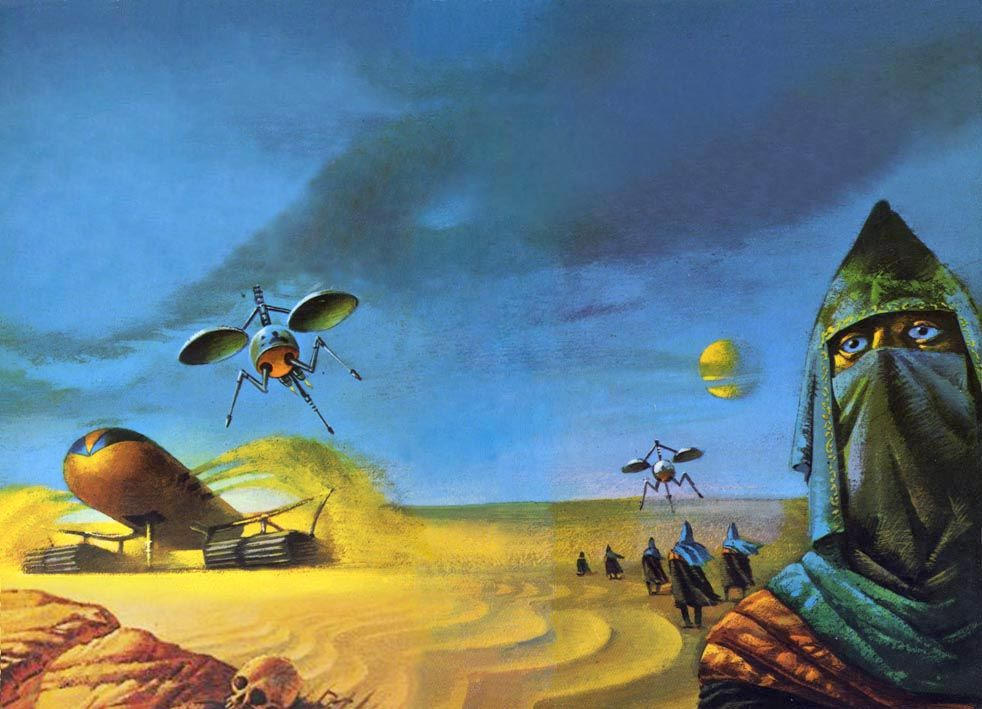
    Based on Dune by Frank Herbert

    Original lyrics: https://www.youtube.com/watch?v=BLONWy46gIE

    Way up north (north to Arrakis)
    Way up north (north to Arrakis)
    North to Arrakis, we go north, the rush is on
    North to Arrakis, we go north, the rush is on

    Leto left Caladan in the year of ’91
    With Jessica, his concubine, and Paul, his only son
    They took a Guild Heighliner and mined the Melange Spice
    Till Harkonnens attacked and killed them all—that wasn’t nice!
    Paul crossed the Shield Wall Mountains to the valleys of the land
    He talked to his team of Fremen as he shuffled through the sand
    With the sandworms a-runnin’ wild in the Land of the Burning Sun
    Yes, Paul Atreides was a mighty man in the year of ’91

    Where the canyon is windin’, Harkonnens they’re findin’
    North to Arrakis, we go north, the rush is on

    Way up north (north to Arrakis)
    Way up north (north to Arrakis)
    North to Arrakis, we go north, the rush is on
    North to Arrakis, we go north, the rush is on

    Paul turned to Gurney with his Spice in his hand
    Said, “Gurney, you’re lookin’ at a lonely, lonely man
    I’d trade all the Spice that’s buried in this land
    For one small band of gold to place on sweet little Chani’s hand
    ‘Cause a man needs a woman to love him all the time
    Remember, Gurney, true love is so hard to find
    I’d build, for my Chani, a sietch of our own
    Upon the planet Kaitain, on the Emperor’s golden throne”

    Where the canyon is windin’, Harkonnens they’re findin’
    North to Arrakis, we go north, the rush is on
    North to Arrakis, we go north, the rush is on

    Way up north (north to Arrakis)
    Way up north (north to Arrakis)
    Way up north (north to Arrakis)
    Way up north (north to Arrakis)

    +
  • When I finally came to, everything was dark. The chamber was pitch-black; the blue glow that had lit the rocks before was gone. I took a breath. The air was clear now—no bitter taste, no sting in my throat.

    What happened? I wondered, pushing myself upright, my body stiff and sore. Why’s it all dark?

    I groped across the floor, feeling cold stone and grit beneath my hands. My fingers brushed against the flashlight. I grabbed it and flicked the switch. Nothing. Dead batteries.

    Figures, I thought. Should’ve packed spares.

    I had no choice but to feel my way along the walls, searching for a weak spot in the pile of rubble that sealed the exit. After a few minutes, I found one—on the left side, where some of the bigger rocks had shifted, leaving a narrow gap, maybe a yard wide. I realized the movement had opened the chamber to outside air again, clearing out the strange gas that had knocked me out.

    Much later, I’d learn that the metallic taste came from a radioactive vapor seeping from the stone—decay gases that had finally burned themselves out. But right then, I wasn’t thinking about science. I just wanted to get out.

    I wriggled through the gap, scraping my elbows on rough stone, and crawled into the passage leading upward. It was just as dark here, but there was only one way to go. I ran my hands along the wall to keep my bearings and climbed.

    After what felt like forever, I saw moonlight—cold silver filtering down the tunnel. I blinked at it, confused. Still night. How long had I been out?

    When I reached the surface, I stepped into the open air—and froze.

    The forest didn’t look right. The trees were different—stranger shapes, unfamiliar outlines against the sky. The trail curved in new directions. Even the moon looked odd. On its dark side, faint grids of orange light shimmered, like city lights back on Earth.

    I’m seeing things, I told myself. I’ve got to be.

    Hallucination or not, I had to get home. I’d tell Mom and Dad I couldn’t find Jake, and they’d call the police. That was the plan.

    I started down the trail, the flashlight hanging useless from my hand. Moonlight guided me most of the way. After a few minutes, I noticed a bright glare ahead, like a searchlight or the lights downtown. It grew stronger as I walked.

    Then I stepped out of the woods—and stopped dead.

    The suburb was gone.

    In its place stretched a vast city of glass and steel. There were no cars or roads on the ground—only wide walkways. They swarmed with people, hundreds of them, moving in orderly streams. The cars were in the air: sleek machines hovering and darting between the towers like schools of fish.

    The buildings soared higher than any I’d ever seen. The nearest ones climbed three hundred meters at least; the ones in the distance—where downtown Los Angeles should have been—vanished into the clouds, two kilometers high or more.

    My jaw went slack. Either I was dreaming, or I’d stumbled into another dimension—or I’d been asleep for a very, very long time.

    I ran, heart pounding, trying to find my street, my house, something familiar. But the city plan was different. The old roads were gone. Everything was new—alien.

    As I ran, the sights grew stranger. Robots of every shape and color moved among the crowds: some walking beside people, others balancing trays or carrying boxes and pizza cartons. Huge white billboards covered the sides of the towers, with movie projectors beaming bright holographic advertisements onto them.

    The adverts read:

    Pan Am Space LinesTravel the galaxy in style!”
    “Ford Jupiter—The Fastest Aircar in the Known Universe!”
    “Tired of Cleaning? Get the IBM 50000 Robo-Helper!”
    “United Stellar Navy—The Galaxy’s #1 Space Defense Service!”

    I stopped cold. Space travel. Aircars. Robots.

    “This isn’t 1981,” I muttered. “When is it?”

    I grabbed the sleeve of a man walking past. “Hey, Mister—what’s today’s date?”

    He blinked, startled. “Why—uh—September 3, 2081,” he said, glancing at his wristwatch.

    The words hit me like a hammer.

    2081.

    A hundred years.

    My breath caught. My mind raced. Mom—Dad—Jake—Alex…dead. All of them. Everyone I ever knew.

    I opened my mouth, but no sound came out. My vision blurred, my knees went weak. The last thing I saw was the man’s startled face as the world tilted sideways.

    Then everything went black again.

    When I woke up, I felt something warm and soft around me—a blanket on top, sheets beneath.

    I breathed a sigh of relief. I’m home, I thought. It was all just a dream.

    I stretched, yawned, and sat up. Then I opened my eyes… and froze.

    This wasn’t my room.

    This place was huge—as big as my old classroom, and twice as tall. My movie posters were gone. So were my Star Wars figures and the box of comics I’d left under my bed. Everything here was clean and metallic—the walls, the floor, even the bed frame. The door wasn’t wood anymore, but a silver panel that looked like something off Star Trek.

    There was a window beside the bed. Outside, I could see the same strange city I’d walked through before—the one with the glass towers and flying cars.

    I pinched my arm hard. Nothing changed.
    It wasn’t a dream.
    The cave, the glowing rocks, the city—it was all real.

    I had no idea where I was, or even when I was.

    The door suddenly slid open with a hiss, and a boy about my age stepped in—brown hair, green T-shirt, blue jeans, sneakers, and a Boy Scout pocketknife hanging from his belt.

    “Hey!” he said cheerfully. “What’s your name?”

    “Uh… Mark. Mark Starman.”

    “Mark, huh? I’m Steve Parker. Nice to meet you!” He grabbed my hand and shook it like we were old pals.

    “Where am I?” I asked. “How did I get here?”

    “This is one of our guest rooms,” he said. “My dad found you passed out on the street and brought you home.”

    I swallowed. “What’s the date?”

    He grinned. “Wednesday, September 3, 2081 A.D.”

    I slumped forward, holding my head. “So it is 2081…”

    “Well, sure,” said Steve. “When else would you be?”

    “It’s a long story,” I sighed. I told him everything that had happened—the cave, the light, the city.

    “Totally warped!” he said when I finished. “Welcome to the twenty-first century, man!”

    “You actually believe me?” I asked.

    “Of course! You’re a real live kid from a hundred years ago. That’s amazing!” He tugged my arm. “Come on—you gotta meet my folks!”

    Before I could argue, he dragged me out of the room, down the hall, and into the biggest living room I’d ever seen. Six meters tall with one wall made of glass, looking over a huge backyard with a swimming pool and a garden. A robot zipped around in the pool, cleaning it. Another polished the dining table with a spray bottle.

    “Wow,” I breathed. “This house is enormous! You must be rich!”

    “Nah,” said Steve. “Just middle class. Our other two houses are a lot smaller.”

    In the room itself was a couch and a TV set in front of it—a boxy beige thing with a curved screen and three or four video game machines plugged into it. On a short table next to the couch was a phone—made of white plastic with a keypad, a handset, and a little curved screen.

    A man and woman sat on the couch—Steve’s parents, obviously. Mr. Parker was the same guy I’d seen on the street, dressed sharp in a suit and ascot. Mrs. Parker wore a puffed-sleeve dress and an apron.

    “Uh…hi again, mister,” I said. “Thanks for helping me.”

    “You’re welcome, son,” said Mr. Parker kindly. “What’s your name?”

    “Mark Starman,” I said.

    He frowned slightly. “Can’t say I’ve met you before. How’d you end up here?”

    I hesitated, then told the story again—the cave, the light, everything. Mrs. Parker’s eyes widened.

    “John,” she said, turning to her husband, “my brother’s a detective. He once read about a boy named Mark Starman—went missing about a hundred years ago. Ten years old, blond hair, blue eyes. They never found him.”

    Mr. Parker studied me. “Go on,” he said quietly.

    So I did. And when I finished, he sighed and put a hand on my shoulder. “I don’t know how it happened, son, but I believe you. You’ve had a rough time.”

    “Can’t you find any of my relatives?” I asked hopefully. “Someone must still be around.”

    “I’m afraid not,” he said. “My cousin is a genealogist, and he once told me the entire Starman family died out in the Great Space War—2050 to ’55. You’re the only one left, it seems.”

    “Great,” I sighed. “Then I guess it’s the state orphanage for me.”

    “We don’t have state orphanages anymore,” said Mr. Parker. “Or a state at all, for that matter. We have private security, private courts, and private naval companies. Speaking of which—how’d you like to join the United Stellar Navy?”

    “Join the Navy?” I blurted. “I’m just ten years old!”

    Mr. Parker chuckled. “Things are different now. Companies hire whoever’s fit for the job—even kids. Plenty of boys your age work in aircar shops, and lots of girls work as secretaries. The naval companies are no exception—they’re always looking for boys your age. Easy to train, don’t question orders much.”

    He handed me a flyer. Big, bold letters at the top shouted:
    HEY KIDS! WANT ADVENTURE? JOIN THE UNITED STELLAR NAVY!

    There was a picture of a smiling boy in a dark blue sailor suit saluting. Bright yellow comic-book bursts to his sides blared out: See the Galaxy! Fight Bad Guys!

    Below the boy was text reading: Boys ages 5-105 eligible. Girls need not apply.

    At the lower right-hand corner was the U.S.N. logo—a blue ringed planet with a silver fouled anchor behind it, with the United Stellar Navy name and the motto, The Galaxy’s #1 Space Defense Service.

    At the very bottom, in tiny print, was a disclaimer: United Stellar Defense Services, Inc. is not responsible for any damage to life or limb incurred by employees on duty.

    Mrs. Parker said, “Steve’s enlisting tomorrow. You could join him.”

    “There’s a commission fee for midshipmen, but we’ll cover it,” added Mr. Parker. “Our youngest son was going to become a midshipman, but he took a job with Pan Am instead.”

    “No way!” I said, stepping back. “I don’t want to get blown up by pirates! I’m not even good at Space Invaders! I’ll just take the auto shop, thank you very much!”

    Steve grinned. “Aw, come on, Mark. Adventure is what makes life worth living! My big brother Herbert says that’s how civilization happens—people risking their lives to achieve great things. Like Christopher Columbus discovering America, Neil Armstrong landing on the Moon, Peter Hawkins breaking the light barrier—”

    “Who?” I asked.

    “Never mind. Point is, you can either stay scared or see the stars.”

    He was crazy. But he was also the only friend I had. And as much as I hated to admit it, being alone scared me even more than space pirates.

    “All right,” I said finally. “I’ll join.”

    “Good idea,” said Mr. Parker. “Get some rest. We’ll take you to the San Diego base at dawn.”

    “Thanks,” I said quietly.

    Steve led me back upstairs.

    “Why do you think danger is so great?” I asked as we walked.

    “My brother’s an Eagle Scout,” he said proudly. “He told me all about the adventures he had on his campouts. Once he rappelled down Olympus Mons to save a kid, and another time he caught a shark on Venus for dinner with his bare hands! After he left the Boy Scouts, he gave me this knife.”

    He unhooked his pocketknife and flicked it open—and the blade unfolded into a full-sized steel sword.

    “Pretty stellar, huh?” he said, swinging it in the air. “Herbert killed five bears and a tiger with this thing. The metal even reflects laser fire!”

    “Put that away!” I yelped, flattening myself against the wall.

    He laughed and folded it back with a click. “Relax, I wasn’t gonna slice you.”

    I pressed a hand to my chest. “Okay. Point made. You’re nuts.”

    “If I get a great adventure, who cares if I lose an arm?” he said casually. “Good night, Mark.”

    “Good night,” I said.

    I went back to the guest room, turned off the lights, and lay staring at the ceiling. Just yesterday, I’d been an ordinary kid. Now my family was gone, my world was gone, and I was supposed to join a space navy run by some heartless corporation. I shut my eyes and prayed I’d wake up back in 1981. But deep down, I knew I wouldn’t. I was trapped in the twenty-first century whether I liked it or not. I drifted off to sleep, trying to forget about what was to come.

  • As strange as it may sound, there was a time in my life when I could honestly say I was the universe’s only 110-year-old boy.

    In other words, I—Mark Alexander Starman—am almost certainly the only man in modern history whose ordinary lifetime of eighty years has stretched across one hundred and eighty. I spent the first ten years—from 1971 to 1981 A.D.—in the late twentieth century, and the next seventy after 2081. The hundred years between I passed in a kind of frozen limbo.

    What happened after I woke up—what I saw and did in the twenty-first century, and far beyond—is what this book is about.

    But before I tell you that story, I’d better explain how I got there in the first place. I remember it like it was yesterday. The date was Thursday, September 3, 1981. The place—a quiet suburb outside Los Angeles. More specifically, Bob’s Video Arcade, where I wasted most of my allowance every week feeding quarters into video machines. That afternoon, I was deep into yet another round of Space Invaders.

    “Come on, Mark!” yelled my best friend Alex over the racket. “Get the bonus ship! Don’t blow it!”

    I was hunched over the controls, fingertips sweating on the white LEFT and RIGHT buttons, eyes locked on the glowing screen. My green cannon zipped under the red saucer crawling across the top. I jabbed the red FIRE button again and again—but every shot missed. The saucer slipped offscreen.

    “Ha!” my kid brother Jake crowed behind me. “Told you you’d miss it!”

    “Shut up, Jake,” I muttered, not taking my eyes off the display.

    The aliens kept coming—rows of little white crabs and squids marching down the curved glass, the electronic soundtrack pounding faster and faster, like a digital heartbeat. I fired wildly. Missed again. The last of my bunkers dissolved into glowing dust. A green alien dropped to the bottom, touched my cannon, and—blip!—that was it. Game Over.

    Jake laughed so loud people turned to stare. “You can’t even beat the first level, loser!”

    “Like you could,” I shot back. “You can’t even reach the fire button, shrimp.”

    Jake stuck out his tongue—his idea of a comeback.

    “Come on, Jake!” called his buddy Billy Baker from the door. “Let’s check out that cave I told you about!”

    “I’m coming!” Jake yelled, bolting toward him. He turned back just long enough to blow a wet raspberry at me.

    “Little creep,” I growled. “One of these days…”

    Alex grinned. “Man, little brothers are the worst. I’m glad I don’t have any.”

    “Yeah, well, even without Jake, I still stink at Space Invaders.”

    Alex shrugged. “Keep at it. Who knows? Maybe someday you’ll win the National Space Invaders Championship on TV.”

    “Sure,” I said. “And maybe pigs’ll fly. I’ve been playing since it came out. Still can’t get past Level One. I’m hopeless. Asteroids, Missile Command, Breakout—same story.”

    Alex elbowed me. “Hey, you never know. You might get better. Maybe you’ll end up flying a real ship someday—fighting real aliens.”

    “Yeah, right. In your dreams. Nobody’s ever gonna fight battles in space.”

    “You kidding?” he said. “Haven’t you heard what’s going on up there? NASA’s got the Space Shuttle flying now—an honest-to-God spaceship with wings. They send it up, it drops off a load, and then it lands in one piece! Not some dinky capsule, either—a full-blown orbiter!”

    “Big deal,” I said.

    “And get this—there’s a private company around here that says they’re building a ship as big as a football field. Nuclear engines and everything! Think about it, man! By the time we’re forty, there’ll be people living on the Moon, maybe Mars!”

    “So what? Doesn’t mean I wanna go.”

    “You’re missing the point! Space travel’s taking off. Colonies on the Moon, mines on asteroids, giant stations orbiting Earth. Then we’ll break the light barrier—boom!—and there’ll be people all over the galaxy: trading, exploring, fighting pirates! And you could be a space cadet, zapping bad guys in zero-G! Doesn’t that sound amazing?”

    “Amazing? No way! I don’t wanna get vaporized over Mars or Vulcan or Tatooine or whatever. I’m fine right here playing Space Invaders, thanks.”

    Alex grinned. “Fine by me. I’ll be first in line when Star Fleet starts recruiting.”

    I checked my watch—5:45 P.M. “Gotta split,” I said. “Mom’ll kill me if I’m late for dinner. Catch you later, Alex.”

    “Later, man.”

    I didn’t know it then, but that was the last time I’d ever see him.

    The arcade doors swung shut behind me as I stepped outside, cutting off the bleeps and bloops. Warm air hit my face. The sky was gold and orange, the sun sinking behind the palms. I blinked a couple times, hopped on my bike, and started pedaling home.

    As I rode, I looked around at the world I’d grown up in, my whole life in one snapshot. McDonald’s and Wendy’s side by side, Sears down the street, K-Mart’s red sign glowing in the dusk. Cars with square chrome grilles and blue-and-yellow California license plates, stereos blasting Journey and Styx. Little kids playing with G.I. Joes and Barbie dolls, teenagers cruising in Camaros with the windows down. The post office, the library, the police station, and my school with its sign that said BACK TO SCHOOL 9/8.

    To the west, the towers of downtown Los Angeles shimmered in the smoggy haze. To the east, the Angeles National Forest turned purple in the fading light. It was the only world I’d ever known, and even with all its flaws, I liked it just the way it was. I had no way of knowing that the next time I closed my eyes and woke up, that world would be gone forever.

    After pedaling a few more blocks, I turned right onto my street. Rows of colorful, nearly identical two-story houses stretched along both sides, their lawns clipped square, their driveways lined with station wagons and sedans. I coasted to a stop in front of Number 32—a cream-colored house with a two-car garage and a mailbox that read The Starmans in neat black letters.

    The garage door stood open, revealing our red 1978 Ford Fairmont station wagon. I rolled my bike inside, shut the door, and stepped into the house.

    “There you are, Mark,” said my mother. She was wearing a spotless apron over her dress and holding a steaming bowl of mashed potatoes. “How was the arcade?”

    “Okay, I guess,” I said, giving a half-shrug.

    “Well, dinner’s ready, so wash up and come sit,” she said, smiling—tired but trying.

    I did as I was told. The dining room smelled of roast chicken, green beans, and mashed potatoes—our usual Thursday night menu. The refrigerator hummed faintly in the kitchen, and from our TV set in the living room came the theme of the CBS Evening News.

    Four chairs circled the oak table. My mother sat in the first, my father in the second—white shirt wrinkled, black tie loosened, reading glasses low on his nose as he buried himself in the Los Angeles Times. I took the third chair. The fourth, Jake’s, was empty.

    “Isn’t Jake home yet?” Mom asked.

    “No, he’s off with Billy Baker. Something about a cave,” I said. “He’ll be back by sundown.”

    Dad didn’t look up. The headline above his folded paper read: REAGAN ADMINISTRATION INCREASES DEFENSE SPENDING—RENEWS ARMS RACE AGAINST RUSSIANS.

    After saying grace, we started to eat. From the TV came Walter Cronkite’s calm, steady voice:

    “…another General Motors plant in Detroit has closed its doors, leaving two thousand out of work. In other news, with inflation and unemployment both hovering near eight percent, President Ronald Reagan insists that his tax cuts and deregulation will bring renewed growth by 1983. Economists remain skeptical…”

    Dad lowered the paper just enough to glare toward the set. “Renewed growth, huh? Sure. Maybe for Wall Street.”

    “Oh, Tom,” Mom sighed. “You’ve been saying that since January. Give him time. The economy’s been a mess for years. Ford couldn’t fix it, Carter couldn’t fix it. Somebody had to try something.”

    “He’s doing something, all right,” Dad said. “Selling the country to the highest bidder. Tax breaks for millionaires, cuts for schools and services. Big business makes a killing, and the rest of us pay the bill.”

    Mom frowned. “You don’t understand. He’s trying to free up the economy, stop the inflation. Do you know what our last grocery bill was? It’s insane! Prices have doubled since we got married. We can’t go on like that.”

    Dad snorted. “Our mortgage is fifteen percent. At this rate, we’ll be paying for the same house until Mark’s got grandkids.”

    “That’s Volcker, not Reagan,” Mom said. “And they both say it’s the only way to stop prices from climbing. Along with having less government, of course.”

    “Less government?” Dad said. “Keep it up and there won’t be a government left. The schools, the roads, Social Security—all privatized. Next they’ll sell off the police, the military—everything. You’ll have to pay every time your house gets robbed or the Russians decide to invade, and they’ll raise the rates every year. The rich’ll get richer, the poor’ll multiply, and the rest of us can go to hell in the meantime. Mark my words, Judy—that’s where we’re heading.”

    A long silence followed. The only sounds were the hum of the refrigerator, the clink of silverware, and Cronkite’s measured voice drifting in from the other room.

    At ten years old, I didn’t understand much of what they were arguing about, but I knew it was somehow important.

    After dinner I went upstairs to my room. I can’t recall exactly what I planned to do—read a comic book, play with my action figures, maybe just daydream—but I remember every detail of that room.

    The walls were papered with posters: Star Wars, The Empire Strikes Back, Star Trek: The Motion Picture, and Disney’s The Black Hole. My Star Wars action figures—Hammerhead, Snaggletooth, Walrus Man—were scattered across the carpet in mid-battle. Under the bed was a cardboard box stuffed with comic books: Superman, Spider-Man, Swamp Thing, and a few others nobody’s heard of in more than a century.

    A lamp sat on my desk. My digital clock blinked 7:58 in red numbers beside the bed, which was covered with a Darth Vader blanket and Captain Kirk sheets. Above the headboard, a wide window looked out onto the twilight sky.

    The sun had slipped below the rooftops, and the first stars were coming out. I sat on the edge of the bed and stared up at them, thinking about what Alex had said at the arcade—the future, the spaceships, the colonies. I imagined thousands of starships streaking through the night at faster-than-light speed, each one carrying settlers to new worlds circling distant suns.

    Then I remembered my father’s talk at the table and imagined all those stars with price tags dangling from them: a hundred trillion for the red one, two hundred for the blue one—buy one, get one at twenty percent off. Even as a boy, I understood that somehow, somewhere, someone would be selling the future.

    I wasn’t sure which was worse—the Russians burning us to ash in a nuclear war, or the corporations buying the pieces afterward. Either way, I wanted no part of it.

    I was perfectly happy where I was: suburban Los Angeles, 1981 A.D. Mom, Dad, Jake, and my friends. My comic books, my video games, and my action figures. I leaned back in my chair, listened to the distant drone of the TV downstairs, and silently thanked Whoever Was Up There that I hadn’t fallen asleep for a hundred years and woken in some brave new world.

    It was around that time that Mom called from downstairs.

    “Mark! Mark!”

    “I’m coming, Mom!” I shouted, jumping to my feet and pounding down the stairs.

    She was dusting the TV, her apron smudged with gray powder. “Mark, could you ride over to Mrs. Baker’s and see if Jake’s there? It’s past eight-thirty, and he hasn’t come home.”

    “Okay, Mom!” I said, already halfway to the door.

    “Don’t forget your flashlight!” she called after me.

    In the garage, I grabbed the flashlight from the workbench, flicked it on, and swung onto my bike. The night air hit my face as I pedaled hard down the block, tires humming against the asphalt. Streetlights flashed past like silent metronomes.

    The Bakers’ house was just five minutes away. I skidded to a stop at their curb, dropped the kickstand, and rang the doorbell.

    After a short pause, Mrs. Baker opened the door. She looked worried, her hair pinned up in the same curlers she always wore at night.

    “Hi, Mrs. Baker. Is Jake here?”

    “I thought he was with you, Mark!” she said. “He and Billy went into the woods two hours ago, and I haven’t seen them since!”

    The little brat, I thought. Now I’ll have to go drag him out myself. I kept my voice steady. “I can look for them, Mrs. Baker. Do you have a map of the woods?”

    “Why, yes,” she said quickly. She reached into her apron pocket and unfolded a piece of paper. “Billy drew this one last week. He made another yesterday, but he took it with him. This is the best I’ve got.”

    I took the map. It was a rough sketch in crayon—our streets, the edge of the woods, a wobbly trail leading to a spot marked with a big X and labeled wierd [sic] cave.

    “Thanks, Mrs. Baker!” I said, hopping back on my bike.

    The night was black and still as I tore down the empty streets, following the route by the beam of my flashlight. I knew I didn’t have much time. Those woods stretched for miles—who knew how deep Jake had gone?

    At the trailhead I braked hard. Two small bikes lay in the grass—Jake’s and Billy’s. “So this is where he went,” I muttered, dropping my own beside them.

    I started down the dirt path, running full speed, flashlight jerking in my hand. The beam bounced ahead, cutting through the trees. The woods loomed tall and black against a sky spattered with cold stars. I could hear my own breathing, quick and loud in the night.

    After what felt like several football fields, the path forked. I checked the map and veered left. Another long stretch, another mile of shadows. Then I saw it: a cliff rising from the trees, and at its base, a dark mouth in the rock.

    The cave.

    I stopped and shined the light inside. The beam vanished after a few yards, swallowed by darkness. I took one step in, then another—and froze. What if I get lost? I thought. What if I hit my head? What if there’s a snake—

    I clenched my jaw. Jake was in there somewhere. That was all that mattered.

    I took a deep breath and walked in. The air grew cooler, heavier. The light bounced off damp stone walls. After a few minutes, the entrance had disappeared behind me.

    Come on, Mark, don’t lose it. I kept moving. The tunnel sloped down, the air tasting faintly metallic. Then the passage opened into a wide chamber—bigger than our school gym.

    I stopped and stared.

    The walls glowed faint blue, like they were lit from the inside. The light shimmered, shifting like slow lightning trapped in stone. The air had that same metallic tang, sharp enough to taste. When I touched the rock, it was warm—almost alive.

    I swept my flashlight across the room. The blue glow flared brighter under the beam. No sign of Jake. No footprints. No side passages. Just the chamber, the light, and the silence.

    He must’ve gone somewhere else. I sighed and checked my watch—past nine. Mom would be frantic. I’d have to head home and call the police.

    I turned toward the tunnel—

    —and my foot caught on a rock. I fell hard, face-first, toward the wall. The flashlight clattered away, rolling across the floor. I threw out my hands to stop myself, hit the wall—

    —and felt something give.

    A low crack echoed through the chamber. A jagged line split the rock, spreading fast. I stumbled back just as a section of ceiling gave way. A roar, a cloud of dust—then the exit was gone, buried under tons of rubble.

    I was trapped.

    Panic hit me like a wave. My heart hammered. My hands shook. Sweat ran cold down my neck. No way out. Nobody knows I’m here. I’m going to die!

    The air grew thicker by the second, heavy with that metallic taste. My head started to swim. My legs went weak. Green sparks danced before my eyes. I tried to yell, but no sound came out.

    I staggered toward the rock pile, reaching for the last gap of light—but my knees buckled. The flashlight slipped from my hand, rolling into the dark.

    The last thing I remember was the strange humming in the walls, low and steady, like something breathing in the stone.

    Then the darkness folded over me, and I fell into it—

    —ending my last night in the twentieth century.

  • +
  • +